
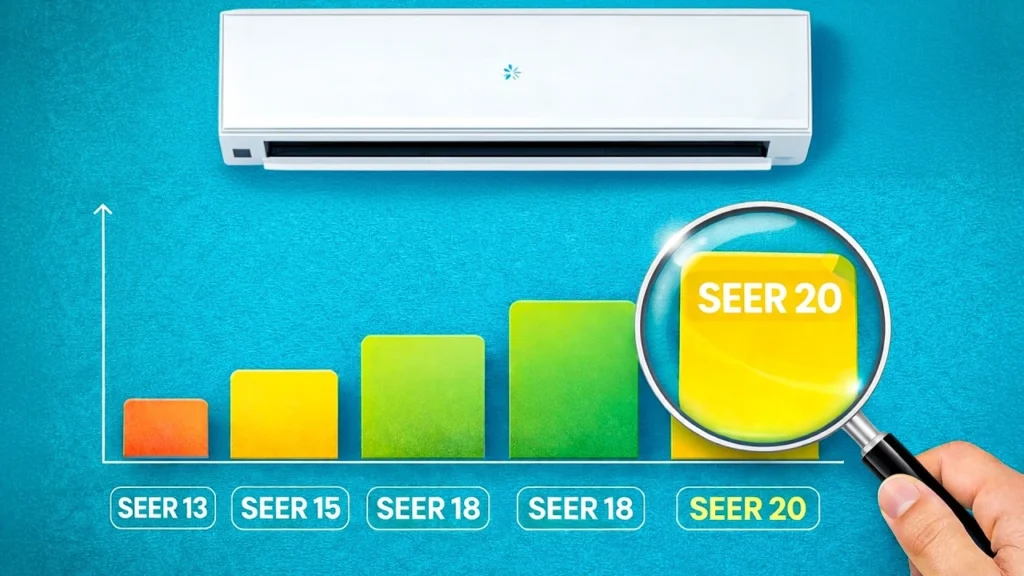
Two air conditioners, same size, and a price gap that comes down to one number. Before Residential AC Installation day, you need to know if that number pays off.
That number is the SEER rating, and it shows up in nearly every sales conversation about cooling. A 20 sounds much better than a 16, and it usually costs more. But does it actually save enough to be worth the premium? The honest answer is that it depends, and the math is simpler than you might expect.
Let’s break it down in plain English.
What Does SEER Actually Mean?
SEER stands for Seasonal Energy Efficiency Ratio. It measures how much cooling an air conditioner delivers compared with the electricity it uses over a typical cooling season. In simple terms, it is the miles-per-gallon rating for your AC.
A higher SEER means the unit turns more of its electricity into cooling. A lower SEER means it needs more power to do the same job. Just like a car with better mileage, a higher-rated unit costs less to run each month, though it often costs more to buy.
SEER vs. SEER2: Why You Will See Both
You may notice a second rating on newer equipment called SEER2. In recent years, the testing method changed to better reflect real-world conditions, such as the resistance air faces moving through ductwork. SEER2 is the newer standard, and its numbers tend to come out a bit lower than the older SEER numbers for the same equipment.
That does not mean the new units are worse. It just means the test is tougher. When comparing systems, make sure you are comparing the same type of rating, either SEER to SEER or SEER2 to SEER2. A good contractor will explain which one applies to the models you are considering.
What are the minimum ratings today?
Federal rules set minimum efficiency levels for new air conditioners, and those minimums have risen over time. They also differ by region and system type, since hotter parts of the country have higher requirements. Because rules can change, it is wise to confirm current requirements for your area before you buy.
The Simple Math Behind 16 vs. 20 SEER
Here is the part most people never get told. The energy a system uses is inversely related to its SEER. That means if you divide the lower rating by the higher rating, you can see roughly how much electricity you would use compared with the other unit.
So, to compare 16 and 20: 16 divided by 20 equals 0.8. A 20 SEER unit uses about 80 percent as much electricity as a 16 SEER unit to deliver the same amount of cooling. That works out to roughly a 20 percent reduction in cooling energy.
In other words, going from 16 to 20 SEER cuts your cooling electricity use by about one-fifth, assuming everything else is equal. That is a real saving, but it applies only to the cooling portion of your bill, not your whole electric bill.
What 16 vs. 20 SEER Might Save You in Dollars
Your actual savings depend on how much you spend on cooling now. Here is a simple, hypothetical example to show how the numbers work. These are illustrations only, not predictions for your home.
Imagine a system rated at 16 SEER costs you $1,000 a year to cool your home. Here is what higher ratings could mean for that same cooling load.
| SEER Rating | Estimated Annual Cooling Cost | Estimated Yearly Savings vs. 16 SEER |
| 16 | $1,000 | Baseline |
| 18 | About $889 | About $111 |
| 20 | $800 | $200 |
| 22 | About $727 | About $273 |
| 24 | About $667 | About $333 |
Now think about your own situation. If your cooling bill is $2,000 a year, the savings double. If it is $500 a year, they are cut in half. This is why climate and usage matter so much.
A quick payback example
Let’s say the 20 SEER system costs $2,500 more than the 16 SEER one, installed. If you save $200 a year, it would take about 12 and a half years to earn that money back. If your cooling cost is $2,000 a year and you save $400, the payback drops to about six years.
These numbers are only examples, since real prices and bills vary widely. But the lesson is clear. High SEER pays off fastest in homes that run the air conditioner a lot.
How SEER Affects Your AC Installation Decision
When you are planning AC installation, SEER is one of the first numbers you will hear, but it should not be the only one. A few other factors can matter just as much, and sometimes more.
Your climate and how much you cool
If you live somewhere with long, hot summers and run your AC for months, a higher SEER has more chances to pay you back. If your summers are mild and short, a mid-range unit may be all you need. A 20 SEER system will not save much in a home that rarely runs the air conditioner.
How long you plan to stay
Higher efficiency pays off over time. If you will be in the home for many years, the savings have room to add up. If you might sell in a few years, a pricier unit may not return its full cost. Some buyers do value efficient equipment, but it is not guaranteed to raise your sale price by the same amount.
Utility rates
A kilowatt-hour costs more in some places than others. Where electricity is expensive, each percentage point of efficiency saves you more money. Where it is cheap, the savings are smaller.
Rebates and incentives
Utilities, manufacturers, and government programs sometimes offer rebates or tax credits for high-efficiency equipment. These can shrink the gap in upfront cost and speed up payback. Programs change often, so ask your contractor and check current offers before you decide.
What Makes a 20 SEER System Different?
A higher rating is not just a bigger number. It usually reflects different technology inside the unit.
Most lower-efficiency air conditioners use a single-stage compressor, which is the part that circulates refrigerant. It runs at full power or turns off, like a light switch. Many mid-range systems use two-stage compressors, which can run at a lower setting much of the time. The highest-efficiency systems often use variable-speed compressors, which adjust output in tiny steps, like a dimmer.
Why does that matter? A variable-speed system can run longer at lower power, which tends to keep temperatures steadier, remove more humidity, and run quieter. Those comfort benefits are often just as important to homeowners as the energy savings.
Why SEER Alone Does Not Guarantee Savings
Here is something many sales pitches skip. A SEER rating is measured in a lab under standard conditions. Your home is not a lab. Several things can keep a high-efficiency unit from performing the way the label suggests.
- Poor sizing. A unit that is too big or too small wastes energy and wears out faster. A proper load calculation, often called a Manual J, matches the system to your home.
- Leaky or poorly designed ductwork. If cooled air escapes before it reaches your rooms, you pay for cooling you never feel.
- Incorrect refrigerant charge. Too much or too little refrigerant lowers efficiency and can damage the system.
- Mismatched equipment. The rating usually applies to a specific pairing of outdoor unit, indoor coil, and air handler. Mixing components can mean you do not get the advertised performance.
- Weak insulation and air leaks. A leaky house makes any air conditioner work harder.
This is why installation quality matters so much. A well-installed 16 SEER system can outperform a poorly installed 20 SEER system. Think of it like running shoes. Fancy shoes do not help if they do not fit.
Is a Higher SEER Rating Worth It for You?
Here is a simple way to think about it.
A higher SEER tends to make sense when you live in a hot climate, run your AC often, pay high electricity rates, plan to stay in the home for years, and value quieter, steadier comfort. In that case, stepping up to 18 or 20 SEER can be a smart investment.
A mid-range SEER may be the better value when your cooling season is short, your electric rates are low, you may move soon, or your budget is tight. A solid 15 or 16 SEER system, installed well, can deliver comfort and reasonable efficiency without a big premium.
There is no single right answer. The best choice is the one that fits your home, your habits, and your budget.
Common Mistakes When Choosing a SEER Rating
One of the biggest mistakes is buying the highest SEER available without looking at payback. Another is ignoring installation quality and focusing only on the label.
Some homeowners compare SEER on one quote with SEER2 on another and think one is better, when they are measuring different things. Others skip the load calculation and let a contractor simply “replace what was there,” even if the old unit was the wrong size.
And many people forget about maintenance. Even the most efficient system loses performance if filters are dirty, coils are clogged, or the refrigerant is low. Regular tune-ups protect your investment.
Choosing the Right Number for Your Home
The jump from 16 to 20 SEER can cut cooling energy by about 20 percent, which is meaningful. But whether that saves you enough to justify the price depends on your climate, your bills, your plans, and the quality of the installation. Look at the whole picture instead of chasing the biggest number on the box.
So the next time you’re staring at two quotes and a handful of confusing ratings, reach out to D&R Home Service. We provide professional AC installation, backed by a team of experts that have spent years helping homeowners choose the right system and install it correctly. HVAC Services in Baltimore, MD D&R Home Service visit to learn more about how we can help you.
Frequently Asked Questions
What is a good SEER rating for a home?
It depends on your climate and budget. Many homeowners choose something in the mid-to-high teens as a balance of cost and efficiency, while hot climates may benefit from higher ratings.
How much does 20 SEER save compared with 16 SEER?
Roughly 20 percent less cooling electricity for the same output. In dollars, that depends on your current cooling bill, local rates, and how much you run the system.
Is a higher SEER system quieter?
Often, yes. Higher-rated units frequently use variable-speed compressors and fans that run at lower speeds, which can reduce noise.
Can I get a high SEER unit and still have high bills?
Yes. Poor ductwork, bad sizing, or a leaky home can cancel out efficiency. A great unit installed in a poor system will not perform to its rating.
Do I need a new thermostat with a high SEER system?
Not always, but variable-speed systems often work best with compatible thermostats. Ask your contractor which controls are recommended for the model you choose.