
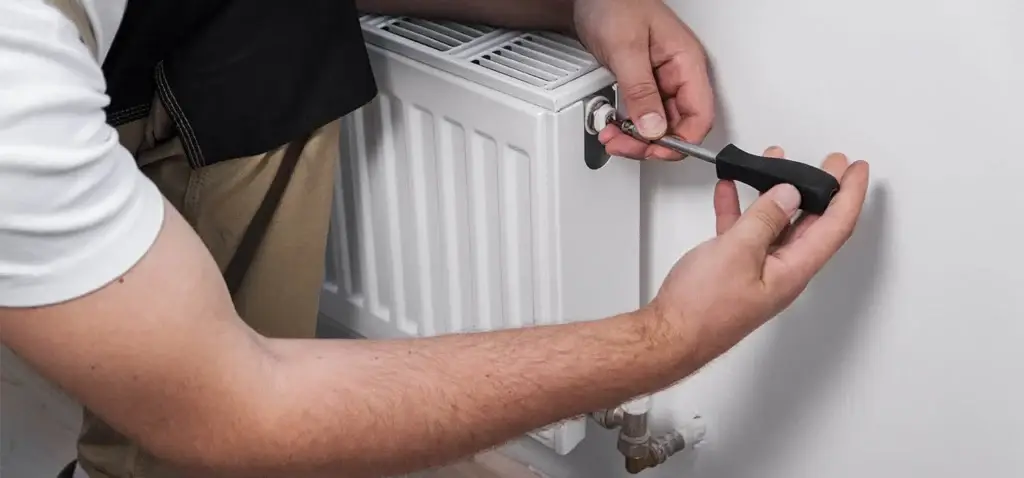
Knowing how to bleed radiators can help restore even heating, eliminate cold spots, and improve your home’s heating efficiency. If your radiator feels hot at the bottom but cold at the top, trapped air may be preventing hot water from circulating properly. With a few simple steps, you can release the trapped air, improve heat distribution, and help your boiler work more efficiently. Here’s how to bleed your radiators safely and when to consider professional boiler services.
Your radiator is hot at the bottom, cold at the top, and gurgling like a coffee pot. Boiler services calls often start with this exact problem, and the fix can take about ten minutes.
That cold patch is not your radiator giving up. It is usually trapped air, and it blocks hot water from filling the whole panel. Once you let the air out, the heat spreads evenly again, the room warms up faster, and your boiler stops working harder than it needs to.
Here is how to do it safely, in four simple steps, plus what to do when bleeding does not solve the problem.
What Does It Mean to Bleed a Radiator?
Bleeding a radiator means releasing air that has collected inside it. In a hot water heating system, a boiler heats water and pumps it through pipes to your radiators. The radiators give off that heat into the room, and the cooled water returns to the boiler to be heated again.
Air gets into this loop more often than you might expect. It can enter during refilling, through tiny leaks, or form naturally as water heats up. Because air is lighter than water, it rises to the top of each radiator and sits there like a bubble in a bottle. The part of the panel full of air stays cold, while the part full of water stays hot.
Bleeding lets that air escape through a small valve so water can fill the radiator completely.
A quick note about steam radiators
This guide applies to hot water (hydronic) radiators. Steam radiators work differently. They have a built-in air vent that lets air out automatically as steam rises, and they are not bled with a key. If your home has a steam system, skip this method and call a heating professional if a radiator is not heating.
Signs Your Radiators Need Bleeding
You do not have to guess. These clues often point to trapped air:
- The top of the radiator feels cold while the bottom is hot.
- You hear gurgling, bubbling, or trickling sounds when the heat is on.
- A radiator takes much longer to warm up than the others.
- A room feels colder than it should even though the heat is running.
- Your heating bills creep up without an obvious reason.
If these sound familiar, bleeding is a good first step. It is simple, cheap, and low risk when done correctly.
What You Need Before You Start
You only need a few items, and you probably already own most of them.
- A radiator key, which is a small, inexpensive tool sold at hardware stores. Some valves also take a flathead screwdriver.
- A cloth or old towel to catch drips.
- A small bowl or cup to hold any water that comes out.
- Optional: gloves, since the water can be hot.
It also helps to have a flashlight, since some bleed valves sit in tight or dim corners.
Step 1: Turn the Heat On, Then Off and Let It Cool
Start by turning on your heating and letting the radiators warm up fully. Walk around the house and feel each radiator, taking note of which ones have cold spots at the top. Those are the ones that need bleeding.
Now comes the safety part. Turn the heating off, and wait until the radiators are cool to the touch. Bleeding a hot radiator can release scalding water or steam. Turning the system off also stops the circulating pump, which keeps more air from being pulled into the system while you work.
If your system has a thermostat, set it to a low temperature or off, so the boiler does not fire up in the middle of the job.
Step 2: Find the Bleed Valve and Prepare to Catch Water
Look at the top corner of the radiator, usually on one end. You are searching for a small valve with a square or slotted center. It is separate from the larger valves at the bottom that control water flow.
Hold your cloth under the valve, and place the bowl below it. Some water will almost certainly come out, and you do not want it on your floor or carpet.
If your house has multiple floors, plan to start with the radiator closest to the boiler on the lowest floor. Then work your way up through the house. That order helps push trapped air toward the radiators you have not bled yet, so you catch it as you go.
Step 3: Open the Valve Slowly and Let the Air Out
Fit the radiator key onto the valve. Turn it slowly counterclockwise, about a quarter turn. You do not need to open it all the way, and you should never remove the valve completely.
You will hear a hissing sound as air escapes. That is exactly what you want. Keep holding the cloth under the valve, and keep the key loosely turned.
Wait until the hissing stops and a small spurt of water appears. Water means the air is gone. As soon as you see a steady stream of water, move on to the next step.
Step 4: Close the Valve and Check Your Boiler Pressure
Turn the key clockwise to close the valve snugly. Tighten it by hand until it stops, but avoid cranking it down hard, since you can damage the valve. Wipe away any water, and move on to the next radiator.
Once you have bled every radiator that needed it, check the pressure gauge on your boiler. Bleeding lets out some air, and that can lower the system’s water pressure. For many residential hot water systems, pressure is typically somewhere in the range of 12 to 15 psi when the system is cold, but the right number depends on your system, so check the manufacturer’s guidance or the markings on the gauge.
If the pressure has dropped below the recommended range, the system may need to be topped up using the fill valve. If you are not sure how to do this, or your system has no manual fill, it is best to call a professional rather than guess.
Then turn your heating back on and let the radiators warm up. Feel each panel again. They should warm evenly from top to bottom.
What If the Radiator Is Still Cold After Bleeding?
This is where things get a little more complicated. A radiator that stays cold could have a different problem than air. A few clues can help you tell what is happening.
Cold at the top, warm at the bottom
This is the classic air problem. Bleed again, and be patient. Sometimes more than one round is needed.
Cold at the bottom, warm at the top
This pattern points to a different issue, usually a buildup of sludge. Over time, rust and mineral deposits can settle at the bottom of a radiator and block water flow. Bleeding does not fix this. The system may need professional cleaning, such as a flush.
Cold in the middle, warm at the edges
This can also indicate sludge or circulation problems. It is another sign that a technician should take a look.
The whole radiator is cold
Check whether the valves are open, whether the thermostat is calling for heat, and whether the boiler is running. If all of that is fine, a stuck valve, a faulty pump, or a blockage might be to blame.
Why Air Keeps Coming Back
If you bleed your radiators once and they are fine for a long time, that is normal. But if you need to bleed them every few weeks, something is letting air in.
Common causes include a small leak somewhere in the system, a failing automatic air vent, a problem with the expansion tank, which absorbs pressure changes, or ongoing corrosion inside old pipes and radiators. Corrosion can produce gas that collects like air.
One warning sign to watch for is falling pressure. If your boiler loses pressure again and again, water is likely going somewhere it should not. That is a job for a trained technician.
When to Call for Professional Boiler Services Instead
Bleeding radiators is a safe do-it-yourself task, but some situations call for expert help. Consider booking boiler services if you notice any of the following:
- Radiators that keep filling with air shortly after bleeding
- Repeated pressure loss on the boiler gauge
- Cold spots at the bottom of radiators, which may indicate sludge
- Strange banging, whistling, or kettling noises from the boiler
- Water leaking from the boiler, pipes, or valves
- Rust-colored or very dirty water from the bleed valve
- A boiler that shuts down, cycles on and off, or will not start
- Any smell of gas, in which case you should leave the home and call your gas utility or emergency services right away
A professional can test pressure, inspect the pump and expansion tank, check the air vents, and flush the system if needed. Regular boiler maintenance also catches small issues before they become expensive repairs.
How Often Should You Bleed Radiators?
There is no fixed schedule. A good habit is to check your radiators at the start of each heating season, since air can collect while the system sits unused. Bleed them again any time you notice cold spots or gurgling.
Many homeowners find that once a year is plenty. Others need to do it more often if their system is older or has a slow leak.
Even Heat, Lower Stress
Bleeding a radiator is one of the easiest ways to improve how your home heats. Warm the system, shut it down, release the trapped air, close the valve, and check the pressure. Do that, and most cold-spot problems disappear. If they do not, you will at least know what clues to share with a technician.
So the next time a radiator stays cold at the top and you are tired of wearing a sweater indoors, reach out to D&R Home Service. We provide professional boiler services, backed by a team of experts that have spent years helping homeowners keep their heating reliable and their homes comfortable. or visit Local Boiler Services in Baltimore, MD to learn more about how we can help you.
Frequently Asked Questions
How do I know if my radiator needs bleeding?
Feel the radiator when it is hot. If the top is cold while the bottom is warm, or if it gurgles, air is probably trapped. A room that heats slowly is another clue.
Do I need to turn off my boiler to bleed radiators?
Yes. Turn the heating off and let the radiators cool before you start. This prevents scalding and stops the pump from drawing more air into the system while you work.
How long does it take to bleed a radiator?
Usually only a couple of minutes per radiator. A whole house may take 20 to 30 minutes, including checking the boiler pressure afterward.
Why is my radiator cold at the bottom?
A cold bottom usually points to sludge, a buildup of rust and debris that blocks water flow. Bleeding will not fix it. A professional flush or system cleaning is typically needed.
What happens if I never bleed my radiators?
Trapped air can cause uneven heating, noisy pipes, and longer warm-up times. Your boiler may run longer to compensate, which can raise energy use and put extra strain on the system.